Wednesday, 21 July 2021

The best of DSiWare - Part 12: Games beginning with 'M'

And so we come to the (alphabetical) half-way mark. With the Zelda franchise putting in an appearance last time out, it shouldn't be too surprising which of Nintendo's gaming goliaths show's their face for the letter 'M'.


Quick recap: To facilitate this exercise I played every game made available on the DSiWare service and, once I weeded out the shovelware, I have divided the remainder into four categories:

Hidden Gems: Games you've probably never heard of that are utterly brilliant
Well Known & Wonderful: Still gems, still potentially brilliant, but perhaps not quite so 'hidden'
Honourable Mentions: Those games that are good, but lack the real spark required to fit into one of the top two categories
Also Rans: Not bad enough to be completely ignored, but probably not quite good enough to warrant higher status

Two caveats: Firstly, I don't enjoy RPGs. Like, at all. So you won't see any of those at any point. And secondly it's very hard to define 'Hidden Gem' on DSiWare, as the service itself was never hugely popular, so please excuse a potential few miss-categorisations along the way!


Hidden Gems


Metal Torrent


What we have here is a bona-fide hardcore vertical shooter exclusive developed by Arika for the DSiWare service. Featuring just eight stages, a tiny hitbox, a screen full of enemy fire to weave through, a special weapon to slow down bullets, and the tried and tested three lives and you're out system... this is about as brutal and 'pure' as bullet hell games get.

But. Should this is all be a bit much, you can play on the game's easy mode.

In this mode your special weapon recharges almost faster than you can use it, the spread of bullets you fire covers the entire screen, getting hit doesn't kill you, and you will finish the game on your first try. Guaranteed.

However, the game is unashamedly built around high-score chasing, and even featured online leaderboards when such a thing was still available. With this in mind the super-easy mode is somewhat forgivable, as getting to the end isn't really the point. The boss designs though, are less forgivable.

There are four in the game and no matter if you're playing on 'Easy' or 'Maniac' mode it is pretty much the same boss each time. The backgrounds, too, lack variety, although there is a lot of style in what we are given.

Even if the 'Easy' mode doesn't really serve as a gateway to the what feels like the game's true form in Maniac mode; for shooter and bullet-hell fans this is an absolute must play that will challenge even the most seasoned veterans of Cave and Capcom, and although the game is very short, it will take many hours of play and practice to get to the end.


Mighty Flip Champs!

I was tempted to put this, and the next game, into the 'Well Known...' bracket as the developer, Wayforward, has carved quite a name for themselves thanks to the often brilliant Shantae series. The two 'Mighty' games on DSiWare have also appeared on a few other platforms but, in the end, I don't think either of these great puzzle games has had the attention they deserve, so here they are in 'Hidden Gem' territory. 

Mighty Flip Champs is a puzzle platform game that makes great use of the dual screens. A fairly simple ladders and hazards style platforming level is drawn out on the top screen. On the touchscreen below, with a wibbly-wobbly effect applied, is another level of similar design. The goal, which (in true idiosyncratic Wayforward style) is to get to and rescue 'Fishman', cannot be reached using just the one level, so you must get our protagonist, Alta, to a good spot in the top screen layout so that the layout on the lower screen can be 'flipped', replacing the existing layout and allowing you to continue.

At first this is quite simple. There will be a gap between Alta and Fishman for example, and flipping up the layout on the lower screen will provide a platform on which to cross it. Later in the game things get much more complicated. There can be up to 8 screens in play, and the feats of memory and lateral thinking required are pretty intense.

Fortunately, Mighty Flip Champs eases you into the experience. The cartoon art and joyful presentation are definitely not indicative of the challenge ahead, but it does gently evolve into the more complex puzzles smoothly over the course of several levels.

When it comes to games developed by Wayforward, the presence of either Matt or Mark Bozon on the production team is key to knowing if it's going to be among their best stuff. Mighty Flip Champs! was directed by Matt, and designed by them both - and this pedigree is clear when playing the game.

It's tight level design, great concept, vibrant presentation, and excellent difficulty curve make it among the very best games I've played on the platform. It has challenge and replay value to spare and will be a game I'll waste no time coming back to once I have completed this blog series.


Mighty Milky Way

Just above, in the Mighty Flip Champs! write up, I mention that the best games from Wayforward are usually easily identified by having either (or both) of the Bozon brothers involved in the development. Mighty Milky Way, however, has neither name appearing anywhere on it's credits. Which means, in just a few short paragraphs, I have rendered my own point completely moot.

In this game our female protagonist (a definite running theme in Wayforward's output) is an alien called Luna who has the ability to create and destroy planets. Each level starts with Luna skipping around the circumference of a small planet that is drawn in simple 2D on the touchscreen. Tap the planet once and Luna will launch into space, should she land back on the same planet a second tap will destroy it, as our heroine sails safely into the cosmos once more. While free-falling through space (during which time you are influenced by the gravity of various bodies) you can tap anywhere to create a new planet to land on or guide you. But to do this you must first have collected enough 'Planet Candies'.

Yes. Sweets that create planets. 

There are a couple of times in the game where it goes full nutzo and collecting confectionary to create planets is just one example. Another would be that Luna, who I will reiterate is an alien, obviously doesn't speak English. She does, however, appear to be quite fluent in French. And there's the chief antagonist who, unlike the cute pink blobs who sometimes hinder your path on the surface of planets, is a giant green robot tyrannosaurus rex that shoots lasers from its eyes.

Wayforward really cornered the market in this happy-go-lucky style of slightly bonkers game design, and I for one lap it up at every opportunity. Mighty Milky Way's gravity puzzles might be a very different to the level flipping of the previous game in the 'Mighty' series, and the development team has not a single person in common, but the atmosphere of joy and fun permeates both, and means that this comes with no less of a recommendation than Flip Champs! did just above. 


Well Known & Wonderful

Mario vs Donkey Kong: Minis March Again

Among the reasons I've been accused of being a hipster, a contrarian, and various less polite variations on that theme over the years is that I have no qualms in proclaiming, as I'm about to do, that I don't like Mario platform games.

Being from the UK, and just that bit older than many people who enjoy classic games, platformers - in the guise adopted by Mario et al - weren't really a part of my introduction to videogames. In the arcades and on the ZX Spectrum games tended towards the more immediate such as R-Type, Jet-Pac, and OutRun, or the more cerebral such as Rebelstar, Knight Lore, and Rampart. I always found platform games somewhere in the middle, offering neither the directness of action packed arcade games of the more deliberate nature of exploration, puzzle, or strategy games.

All of which is a lot of background to talk about a Mario game that isn't a platformer. This is major plus for me as I get Nintendo's usual first party quality, with none of the faux inertia and mawkish delivery that plagues their mainstream efforts.

In case you've not played and of the Mario vs Donkey Kong games before, they generally involve an amount of puzzle platforming in which you direct robotic 'Mini Mario's' to an exit as you chase down DK.

Unique to this particular version, the gameplay has a lot in common with Lemmings. This largely manifests in the Mini's wandering about the stage freely, leaving you to manipulate elements of the stage on the touchscreen to guide them to the exit. This is a well worn path, but there's no doubt that it's delivered here with style. There are extra goals to achieve in every level, the addition of a tight window to get all your Mini's through the exit, and the not insubstantial addition of a level creation mode which, despite losing a chunk of it's appeal to closed servers, is still a lot of fun to tinker with.

As you would expect of Nintendo, then, this is a class product that, despite being fairly derivative and having fallen slightly victim to the march of technology, remains just a simple and entertaining puzzle game of very high quality.


Mr Driller: Drill till You Drop

There's a little personal irony in selecting this game in the 'Well Known...' bracket as, until a few days ago when I played this, I had never tried any game in this 20+ year old franchise.

And what I fool I've been. This gloriously colourful and instantly playable series is an absolute joy. 

If (like me a little while ago) you've never played the game, it works almost like a reverse Tetris. You start with a 'well' full of blocks and have a character (4 are available to choose from in this version) who stands on top of them and drills down with the goal being to reach a depth specified at the start of the level.

There are obviously complications on this simple format. Firstly you can drill in all four main directions. Secondly, blocks falling from above will crush you. Thirdly, you have to collect air capsules as you go. And, finally, the blocks here link by colour. This means you can sometimes clear very large areas, that spread in all directions, by drilling a single spot on a large mass of, say, green.

This all comes together into a wonderfully addictive package, with great music, sound effects, and visual design combining with the easy to play, yet hard to master mechanics.

Whether you're an old hand or recent convert like myself, Drill till you Drop is a fantastic action puzzler that has made me an instant evangelist of the brand.


Also Rans

Magnetic Joe


A mobile port that starts promisingly but quickly asks you to be quite accurate with mechanics that are not fit for purpose.
Guiding a ball through a maze using magnetic force is exactly the kind of simple game I can usually get behind - but the inaccuracy of control offered here makes the whole thing unforgivably frustrating.


'N' is, obviously, up next but I have a sneaky suspicion we'll be in for a double bill again.

Until then, thanks for reading, I'd love your thoughts and feedback in the comments.

See you next time.

Wednesday, 14 July 2021

The Best of DSiWare - Part 11: Games beginning with 'L'

A certain very well known and well loved franchise features among the five games I've selected under 'L' but, more importantly, this week sees a trio of hidden gems unearthed.

Quick recap: To facilitate this exercise I played every game made available on the DSiWare service and, once I weeded out the shovelware, I have divided the remainder into four categories:

Hidden Gems: Games you've probably never heard of that are utterly brilliant
Well Known & Wonderful: Still gems, still potentially brilliant, but perhaps not quite so 'hidden'
Honourable Mentions: Those games that are good, but lack the real spark required to fit into one of the top two categories
Also Rans: Not bad enough to be completely ignored, but probably not quite good enough to warrant higher status

Two caveats: Firstly, I don't enjoy RPGs. Like, at all. So you won't see any of those at any point. And secondly it's very hard to define 'Hidden Gem' on DSiWare, as the service itself was never hugely popular, so please excuse a potential few miss-categorisations along the way!


Hidden Gems

Libera Wing

It's very noticeable, playing through all these games, that the era in which the DSiWare service launched was also the apex of the Tower Defence trend. Fortunately, most of those I've come across so far have attempted to bring some little twist to proceedings, none more so than Libera Wing.

Each level in this nicely presented, if occasionally scrappy, game starts with a tower offence section where you must use your abilities to guide your ship and a small group of drones to the goal. The little nano-ships proceed to the goal automatically, so it's up you to ensure they arrive safely by using various weapons; a virus that will freeze all turrets for a short period, for example, is the first to come to mind.

Once you've successfully guided your small squadron to their target, the second, more traditional tower defence, part of the game begins. In this part, the ships you previously escorted are used to power-up turrets as the enemy surges to re-take the base you just invaded. Truthfully, this feels less special than the inverted approach of the opening, which is to be expected really, but the whole cycle taken together is pretty creative and, more importantly, a lot of fun to play.

The scrappyness I mentioned earlier comes from the comic style story sections that take place between levels. These are not of particularly high quality and feature regular grammatical errors. Artwork, too, is repeated and reused a little too often.

But, for me, this kind of thing is expected in a true hidden gem. The imperfections add to the charm and the original, entertaining gameplay takes care of the rest.


Looksley's Line Up

Good Feel are a company with a real flair for the visual. Developers of Kirby's Epic Yarn and Yoshi's Woolly World, along with the exceptional and oft forgotten 'Wario Land: Shake It!', they always bring a strong, consistent aesthetic to their work. 

With Looksley's Line Up (AKA the much less snappy: "Tales in a Box: Hidden shapes in perspective!") they not only bring their usual visual flair, but additionally make it a genuine part of the experience.

Guided by the titular Looksley, a white rabbit of the usual Alice in Wonderland temperament, with the use of some rudimentary (and lets be honest: Sometimes a little janky) face tracking technology, the object of the game is to move the DSi around and change the angle through which the paper-craft-esque dioramas are viewed.
In doing so, you reveal hidden words and letters. Each level has several to find and you can't progress until they have been discovered.

It sounds incredibly simple and in concept it is, but thanks to some wonderfully devious placement and the later introduction of moving elements, I have no doubt that this game will keep you entertained far beyond what you would expect after completing the first level.

Between the surprising level of challenge, the attractive design, and the brilliant concept, this is a simple game that is nevertheless very easy to recommend. Make sure you get that camera calibration right before you start though, because on a technical front the game's ambition very nearly outstrips the hardware's abilities.


Link n Launch

There's a couple of games from way back in the glory days when physical distribution was the norm, that mocked the player for getting stuck-in before reading the manual. Unirally on the SNES springs to mind as one that said something along the lines of 'So you tried to play the game, failed, and now your back here' on the first page of the booklet.

To be clear, Link n Launch doesn't do this. For starters there's no manual, obviously, but I was reminded of these jibes when I fired up the game, completely ignored the tutorial levels, and immediately regretted it.

Link n Launch isn't really that complicated, it's just that it's slightly more complex than you'd expect from something that initially appears to be a Pipemania clone.

It's an easy assumption to jump to. There are pipes and you do need to manipulate tiles to complete a route. If you're not familiar with Pipemania you may know this kind of thing as the hacking mini-game from Bioshock. However, in this game, the similaritys pretty much end with the pipes.

In Link n Launch you have to link fuel lines to a rocket in order to launch it up the screen. Most of the pipework is in place for you and can't be manipulated but there are gaps that need to be bridged/connected before the craft can take off.

All the tiles required to achieve this are on the play area to begin with. They are coloured green and must be 'rolled' or flipped into position to direct fuel to at least one of the three boosters on the ship.
This rolling and flipping action adds a devious level of challenge to the game, but it doesn't end there. Feeding just the right or left booster will launch you diagonally to one side, allowing you direct yourself to special areas and steer away from the edges of the play field.

There's upgrades and other gameplay enhancements too, and everything combines with the lo-fi design aesthetic to make this ostensibly very simple puzzler incredibly charming and addictive.


Also Rans

The Legend of Zelda Four Swords Anniversary Edition


So here's a confession that might surprise/annoy you: I've never enjoyed a Zelda game. I've tried almost all of them over the years but, I think primarily because my love of games is born from the arcade experience, I've not got very far in any of them.

The tone of the Zelda series is also something that I don't enjoy. There feels like a constant undercurrent of twee-ness in all of those I've played. I don't think it's any coincidence that the Zelda title I enjoyed the most was Minish Cap, a game developed outside the usual influences by Capcom.

Now, when it comes to the consumption of media, objectivity is, obviously, a complete myth. But with that said, it would be ridiculous of me to ignore the enormously high regard in which the series is held. It doesn't change my opinion but, on the off chance that the reader didn't already know about this enhanced port of the GBA game, I wanted to at least draw it to their attention.


Let's Create Pottery

An attempt to make a 'Zen Bound' or 'Bonsai Barber' style relaxing puzzle game that falls foul of some buy/sell mechanics that don't really work and inconsistent register of stylus activity.

There's a lot of snobbery about this kind of game that I refuse to buy into, but there's no getting away from the distinct lack of entertainment or quality on offer here.


We'll be hitting the alphabetical halfway-mark next time as 'M' is next up. I feel like 'L' is a tough act to follow, so I look forward to seeing what it has to offer.

Until then, thanks for reading, I'd love your thoughts and feedback in the comments.

See you next time.

Wednesday, 7 July 2021

The Best of DSiWare - Part 10: Games beginning with 'J' & 'K

'J' has always proven difficult when I've done alphabetically organised lists before, so it's no surprise that I'm including the equally limited selection from games beginning with 'K' alongside it this week.

Quick recap: To facilitate this exercise I played every game made available on the DSiWare service and, once I weeded out the shovelware, I have divided the remainder into four categories:


Hidden Gems: Games you've probably never heard of that are utterly brilliant
Well Known & Wonderful: Still gems, still potentially brilliant, but perhaps not quite so 'hidden'
Honourable Mentions: Those games that are good, but lack the real spark required to fit into one of the top two categories
Also Rans: Not bad enough to be completely ignored, but probably not quite good enough to warrant higher status

Two caveats: Firstly, I don't enjoy RPGs. Like, at all. So you won't see any of those at any point. And secondly it's very hard to define 'Hidden Gem' on DSiWare, as the service itself was never hugely popular, so please excuse a potential few miss-categorisations along the way!


Well Known & Wonderful


Jelly Car 2

Jelly Car 2 offers a rather neat lens through which to view the pitfalls of digital distribution.

Upon release, this DSiWare port, along with it's pretty much identical siblings on PSP and WiiWare, were criticised for offering less content than the iOS version at a higher cost. Fast forward a little over a decade and the various states of preservation for iOS and Nintendo software and firmware means that these 'lazy ports', as games like this were branded at the time, are by far the easiest way to play this fun puzzle-platformer.

Jelly Car 2 is presented as hand-drawn assets with made-by-a-human sound effects and signature 'soft-body' physics.

The levels are mostly structured as left-to-right challenges with all the moving platforms and jumps that you would expect. There are power-ups too, such as sticky wheels, and the ability to temporarily increase the size of your car.

With these tools at your disposable you advance towards the goal in as fast a time as the wobbly, weight shifty, bouncy physics allow.

It's all exactly as much fun as it was 10 years ago, with some genuine head-scratcher levels and others that are just about careening along as fast as possible.

There's an additional long jump mini-game and another that's a basically a colour sorting machine that's more entertaining than it has any right to be.

All in all, whether you're revisting this as a lost phone favourite, or playing for the first time, Jelly Car 2 is a lot of fun, both in it's (perhaps a little try-hard) presentation and in it's pick-up-and play design.


Kubos (Art Style Series)

Yet another Art Style game with a different name in every territory. This one is known as Precipice in North America and Nalaku in Japan, I'm in the UK though, so Kubos it is!

By this point I probably don't need to tell you that any entry in this series has a minimalist audio-visual style. This time round, Kubos' main play screen is a five by five layer of cubes. Atop which stands a little silhouette character who serves as your player.

Points are scored by walking over the top of as many of these cubes as possible. Hazard and progress is provided by the same means; additional cubes that fall from the sky.

When you first start the game there is only a single mode. The aim of this is ascend ten levels. So, as the new blocks fall from above and build a new layer you have to climb, ever upwards, to the goal. There's the additional jeopardy of only three levels being viable at once, with the lowest one periodically disappearing into the abyss below, and further complexity is added with health pick-ups and a shove ability earned by standing on special cubes.

Getting up to the tenth level opens a second play mode. In this 'Endless' version the play area is reduced to three-by-three with the unsurprising goal of staying alive and scoring as many points as possible.

And, as much as that sounds limiting, it's actually Endless Mode where the game really shines. The pace of this mode suits a game of this style much better, and it bring a good old fashioned kind of 'just one more go' addictiveness.

Kubos might not be the best or most striking game in the Art Style series, but it's nevertheless a very worthwhile game in the DSiWare library.

Testament, I think, to the carefully curated efforts that have made their way to the Bit Generations/Art Style brand over the years.


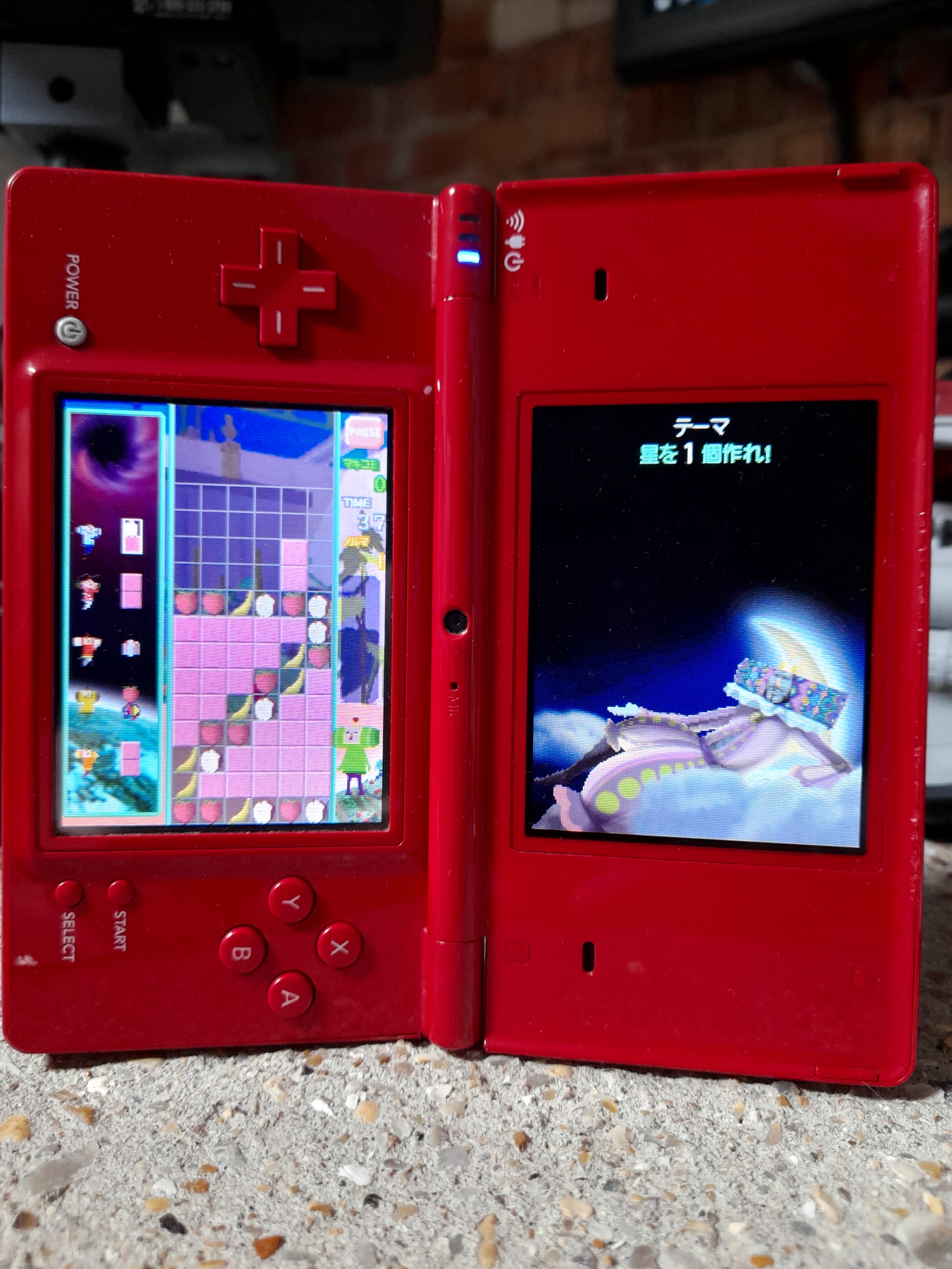
Korogashi Puzzle Katamari Damacy

In an effort to moderate your expectation, I should say up front that this isn't a Katamari game as you would recognise it. Interestingly, though, you might recognise it as something else.

It will be fairly obvious, to anyone who has played it, that Korogashi Puzzle is nearly identical to Pac-Attack; the Tetris-esque block puzzle that Namco Released in 1993. If you're familiar with Pac-Attack you'll know that it had a mechanic whereby ghosts needed to be lined up in a row in order to turn blue so that a Pac-Man tile could be dropped to clear them. Obviously this situation would not fit well in the world of Katamari, so it has been removed.

What's doubly interesting is that this is actually makes the game even more similar to Cosmo Gang: The Puzzle, the 1992 arcade game that was tweaked and re-skinned as Pac-Attack in the first place.

All three games have the same basic mechanic; a combination of square bricks and 'character bricks' fall from the top of the screen. Square bricks can be eliminated by forming horizontal rows, character bricks must be removed by dropping the respective game's title character(s) into the 'well' - who will destroy/eat/roll them up.

Katamari's own twist on the formula is that 1 of three blocks can be chosen, with the stylus, to fall into the play area next.

Going all the way back to it's origins, this was always a fun if unspectacular falling-block puzzle game, and despite the usual off the wall art and sound effects Korogashi Puzzle Katamary Demacy can be described in much the same way.

It's nevertheless nice to play a game of this type that offers something a bit different, so if you've never come across Cosmo Gang or Pac-Attack then consider that an extra tick in the 'should play' column. For anyone else it's a more guarded recommendation, given additional hesitancy by the fact there is no English language version available, so an amount of muddling through the menus is required. 


Honourable Mentions

Jump Trials and Jump Trials Extreme

I was unsure as to whether I should list these two together but, as much as 'Extreme' is definitely it's own game, the improvement over it's predecessor are pretty iterative, so I think this is the right way to go.

At their core both games are the same. We're back in stick-figure platformer territory here with a ten second time limit in one mode, and a bronze, silver, or gold award system in the other.

You control the little avatar with the d-pad and 'A' button, so moving and jumping are the limits of your abilities. Using this set of skills you have to navigate a series of single and multi-screen levels replete with traps and hazards.

As previously mentioned, the difference between the two games are minimal. In the first game the graphics are beyond simplistic, in the sequel a little more colour is added. In the original jumping is a tad floaty, in the sequel this has been improved. Most notable of all, however, is the addition of a quick-restart button (select) which is essential for this micro-platformer sub genre and felt like a bad omission in the original game.

And, in that genre, this is a decent entry. It's obviously not as polished as something like Super Meat Boy, and not as devilishly difficult as VVVVVV, but it does it's own thing with a certain amount of commitment - especially in the sequel - and for me, that should be applauded.


Also Ran

Jagged Alliance

Yes. That Jagged Alliance.

Imagine playing the PC version of Jagged alliance on a 4 inch screen with broken stylus controls. Congratulations you just imagine Jagged Alliance on DSiWare - a good idea, badly implemented.


Hopefully 'L' will offer enough quality to avoid a double-header again next week.

Until then, thanks for reading, I'd love your thoughts and feedback in the comments.

See you next time.

Wednesday, 30 June 2021

The Best of DSiWare - Part 9: Games beginning with 'H' & 'I'

I'm covering two letters this week as the selections for both 'H' and 'I' are pretty slim pickings - they do include one of my favourite puzzle games of all time though!

Quick recap: To facilitate this exercise I played every game made available on the DSiWare service and, once I weeded out the shovelware, I have divided the remainder into four categories:


Hidden Gems: Games you've probably never heard of that are utterly brilliant
Well Known & Wonderful: Still gems, still potentially brilliant, but perhaps not quite so 'hidden'
Honourable Mentions: Those games that are good, but lack the real spark required to fit into one of the top two categories
Also Rans: Not bad enough to be completely ignored, but probably not quite good enough to warrant higher status

Two caveats: Firstly, I don't enjoy RPGs. Like, at all. So you won't see any of those at any point. And secondly it's very hard to define 'Hidden Gem' on DSiWare, as the service itself was never hugely popular, so please excuse a potential few miss-categorisations along the way!


Well Known & Worthwhile


Ivy the Kiwi? Mini

In case you're unfamiliar with this title I should probably make it clear that the question mark isn't a typo. The plot of the game (such as it is) involves a young flightless bird and a quest for her identity.

Story, however, is not at the forefront of this experience. This is a kind of endless running puzzle platformer where our cute protagonist runs, initially left to right, and must be guided over and through obstacles by manipulating 'vines'.

These are drawn directly onto the touchscreen in real-time. This means that not only can you draw bridges and ramps, but you can also use them to flick Ivy around the levels.

It's a compelling mechanic, and one that encourages experimentation, but over the course of this 'mini' version's 50 levels it runs out of steam a little. The full game, released physically for the DS and the Wii, had the same 50 'Story' missions, and extr a50 besides, so there's an argument that the downscale to fit the limitations of DSiWare has done the game a favour.

Yuji Naka has made a career of making games that are 'pretty good' since the heady day of Team Sonic, and Ivy the Kiwi? is no different.

It's a great idea, and fun to play in short bursts, but it lacks a little in depth and variety to be considered an essential play.


Intersect (Art Style Series)

Back in 2005, around the time the Game Boy Micro was released, a series of simple, stylish games were released - Minimalist console, minimalist games.

6 of the 7 were developed by Skip Ltd, the 7th, and last was Digidrive - the first game developed by Q-Games, the company who went on to make the brilliant 'Pixeljunk' games.

The idea of  'Bit Generations' didn't die with the GBA. Three of the games were brought to the WiiWare service under the same 'Art Style' banner that we've already seen plenty of on this blog. A fourth, Digidrive, was the only one of the 7 originals to make it to DSiWare, where it was rebranded (in PAL regions) as 'Intersect'.

The game is quite difficult to explain. So please trust me when I say it is a fantastic, tense, original puzzler that balances risk and reward better than most other games in existence. You should absolutely go and play it right now - before I make it sound far more complicated than it actually is.

The main play area is a cross shape that mimics the d-pad. Different coloured chevrons, probably representing vehicles, travel along the arms of the cross from the outside. When they reach the centre they must be directed in one of the other three directions. Here, if they match, they stack up, waiting for a multi-coloured chevron to arrive and fire them into the 'Plunger'.

Still with me?

The Plunger is on the right hand side of the screen. It slowly lowers as you play and if reaches the bottom it's game over. But, by stacking and firing chevrons into it, an explosion is set off that pushes it back up, away from the bottom of the screen.

And that's it. Direct traffic, build chains, charge the plunger, build the score. There's also layers of multipliers to consider as well as that risk/reward balance of when to keep stacking and when to cash-out, as it were. It starts very slowly but the whole thing builds to an incredible pace and it becomes a genuine feat of mental agility to keep on top of all the elements.

I don't want to oversell Intersect/Digidrive, but when I played it back in 2005 I thought it was the best puzzle game I'd played since the original Tetris. Not only do I stand by that today, but I also haven't played anything better since.


Honourable Mentions

Hero Puzzle (G.G. Series)

You'll be getting the idea of 'Honourable Mentions' by now, games with good ideas that don't do enough with them - and the games that form the 'G.G. Series' are becoming a permanent fixture here.

Hero Puzzle takes the Tetris format and applies old school RPG elements. Match 3 swords and you'll attack your CPU controlled foe, three shields will defend against their assault.

It's a neat concept, but as mentioned in the preamble, it doesn't do enough with it. For starters it's very very slow. I suspect this is an attempt to drag out what is a very short game, but I'd rather a few repeated bosses if the benefit let the dev's double the game's speed.

It's worth a go to see a fun idea play out, and you might even get through to the end, but it's unlikely you'd ever play it again if you did.


Horizontal Bar (aka Let's Swing) (Go/G.G. Series)

When I first started playing this one I thought it was destined for the 'Also Rans'. After a couple of minutes I was hopeful for a 'Well Known...'. Ultimately though, this is the right level for a game that - you guessed it - is fun for a short while but doesn't really evolve enough from it's central concept.

That concept involves jumping to, and spinning around the Horizontal Bars of the title and releasing at the right time to propel yourself to the next. And the next. And the next, until you reach the exit.

Learning the correct timing to get this right will take a good few levels, but that challenge is sadly the last one you'll come across. With the basic level design not bringing enough changes or complexities as they go, it won't be long before you've seen everything the game has to offer - despite being a long way from the end.


Also Rans

Hero of Sparta

I went on at length last time about the perils of judging a book by it's cover. That was in relation to a game that was ostensibly childish but, in reality, was a challenging and brilliant action puzzler.

The opposite is true of Hero of Sparta, a game that looks like it's going to be a neat God of War clone but ends up a damp squib lacking challenge, clarity, and anything approaching player agency.


And that's it for 'H' & 'I'.

'J' is often pretty barren ground when it comes to alphabetical game list making - so we might get another double-header next time. 

I guess we'll find out in a week or so, see you then!

Tuesday, 22 June 2021

The Best of DSiWare - Part 8: Games beginning with 'G'

A nice selection to get through this week, with three games receiving the illustrious Hidden Gem status - so let's not hang about.

Quick recap: To facilitate this exercise I played every game made available on the DSiWare service and, once I weeded out the shovelware, I have divided the remainder into four categories:


Hidden Gems: Games you've probably never heard of that are utterly brilliant
Well Known & Wonderful: Still gems, still potentially brilliant, but perhaps not quite so 'hidden'
Honourable Mentions: Those games that are good, but lack the real spark required to fit into one of the top two categories
Also Rans: Not bad enough to be completely ignored, but probably not quite good enough to warrant higher status

Two caveats: Firstly, I don't enjoy RPGs. Like, at all. So you won't see any of those at any point. And secondly it's very hard to define 'Hidden Gem' on DSiWare, as the service itself was never hugely popular, so please excuse a potential few miss-categorisations along the way!


Hidden Gems


Go! Go! Island Rescue!

The idiom that tells us not to judge a book by it's cover has been around in one form or another since the mid 19th century. Taken literally, it could not appear more anachronistic than when applied to digital video games - and yet I'm not sure there is any other form of media to which it is more relevant.

The digital gaming era emerged contemporaneously with Youtube; a time when visual media has grown exponentially and snap-judgements became the norm.

Go! Go! Island Rescue! may not actually have a cover, but I would imagine a large number of people read the title, saw the icon, maybe even saw a Youtube trailer - and quickly moved on from what they believed was a child's game.

The opposite, we shouldn't forget, is then probably also true: Youngsters or parents would have made a judgement on the same criteria and are likely to have been infuriated by what turned out to be a tight, creative, and challenging action-puzzle game - because that is exactly what lies beneath the cheerful cartoony graphics, bright and breezy presentation, and a title with almost as many exclamation-marks as words. 

The game takes place from the standard 2D perspective and looks much like any number of similar games from over the years. There are ladders and pits, platforms and traps. 

As a firefighter on one of four island locations, it is your job to rescue the locals - or 'Darwins', to give them their proper, slightly over-literal, name by guiding them safely to the exit of each level.

As their name suggests, Darwins will run around in blind panic without your interaction. There may be fire between them and the exit, for example, which will need to be extinguished. 

Unlike the NPCs, our heroic first-responder is controlled directly. You move about the level collecting fire extinguishers, catching falling Darwins, throwing them at the exit, and so on. Yes. Throwing them.

Throwing Darwins is a major part of the fun in the game. Quite often they will need to be hurled across gaps, onto higher platforms, or over flames. And it's not just them. I'm not sure what school of fire-safety our hero attended, but Fire extinguishers, too, are thrown directly into the flames. It appears to work though so, I guess, whatever means necessary!?

As you would expect, mechanics gradually get more complicated with the introduction of NPCs that follow set paths, levels with multiple exits, and other new elements that keep the game fresh and challenging.

Which brings me back to books and covers. Marketing works. It's not a billion dollar industry for nothing. Go! Go! Island Rescue! has a difficulty level and complexity that is clearly aimed at an experienced audience. At some point in it's post-development the decision was made to market it otherwise and this can't be seen as anything other than a huge mistake. 

On the flipside, there's probably a kid out there in the world who's first experience of a 'real' (for lack of a better word) video game was this excellent little gem of a puzzler. Envy that kid.


Go! Go! Kokopolo

Of entirely no relation to the game above, this is nevertheless another action puzzle game with a cartoony design. However, here it's much less geared towards the very young. Kokopolo, our scratch happy feline protagonist (who put me in mind of Professor Genki from the Saints Row series) comes from the Sonic the Hedgehog school of 'edgy' design.

This is a game that feels very much based in the maze games of old; Pac-Man or Clean Sweep, for example. Kokopolo can walk, run, and jump around the levels attacking enemies as he goes. Unfortunately for him, his attacks only serve to annoy these various creatures who will then begin to chase him. 

It's here that the main mechanic of the game comes in. The Mazes are filled with various traps and pitfalls that Kokopolo is equipped to avoid but his enemies are not. So, the player must run away, avoiding other enemies, and eventually leading his pursuers into one of these traps.

Despite being a game with quite a steep learning curve, it's also one that, for me, really nails great replayability. It's one thing to offer the player a time trial mode, but it's quite another to make them actually want to play it. 

Every level could be cleared by meticulously working through the enemies. But most, maybe even all, can also be cleared in one long smooth run. With the experience bolstered by the quality graphics and visual style, I found the desire to go back and do a run that looked as much like a cartoon as possible almost irresistible.

For me, there isn't much greater praise.


Glow Artisan

Colour-mixing puzzle games are nothing new. Even before their ubiquity on mobile phone platforms applying the concept that 'yellow and red make orange' has been an ever present in the medium for decades.

So what's Glow Artisan, the most pretentiously named game in history, doing here as a Hidden Gen if the concept is so rote? Well, simply put: It has great rules.

Even the simplest games need rules. Think of the most basic childhood game; 'Tag', or 'It', or whatever your regional name for it was. Rule 1: Chase someone with the aim of making any physical contact. Rule 2: If the chaser tags the runner the roles immediately reverse.

Glow Artisan has rules almost as simple, but they work to bring the game such beautiful complexity.

On the DS's top screen is a pattern, formed on a grid, made up of between 2 and 8 colours. You are tasked with matching this pattern on a second grid on the touchscreen, using only the primary colours, in as few 'moves' as possible. In doing this, you are restricted by the following rules...

Rule 1: Colours must be 'pulled' from the top or left side of the grid. This means that if you want to colour the fourth square red, you must draw a line from the edge from square one, then two, three and finally four. Think of like stacking, only sideways, or upside down!

Rule 2: You can mix colours to create sub-colours; Blue+Red = Purple, etc by overlaying or crossing over one colour with another.

Rule 3: You can erase the colour from squares, but only by deleting an entire row or column

And that really is just about it. Using only some fiendish grid designs and applying these rules the game becomes tortuously compelling. There's no time limit or other 'urgency' in the game, so it falls into the sub category of 'Zen Puzzlers', and the mental agility and focus required to unpick the levels later in the game make it very worthy of this title.

It may ostensibly be very simple, but prolonged play will reveal a game of genuine complexity, challenge, and quality.


Honourable Mentions

Game and Watch (All)

There were nine 'Game and Watch' releases on DSiWare spread over two years and, as you would expect, they are of hugely varying quality. There are examples here that are still eminently playable, like Donkey Kong Jr., but there's also games of such moronic simplicity that they would fail to entertain even the most basic brain for more than a minute or two, like Ball.

If you, like me, have zero nostalgia for any of these titles then I would posit that none are really worth going out of your way to play. However, if you do remember some, or all, of them fondly then the presentation and extras offered are actually pretty cool and will doubtless bring a rosy-hued smile to your face.


Galaxy Saver

A neat twist on the fixed position shoot 'em ups of old like Space Invaders or Galaxians, Galaxy Saver attaches your craft to the outside of a circular force field protecting a planet.

Waves of enemies attack from every direction and it's your job, using a combination of the radar on the top screen, a limited arsenal, and a personal force field to fend them off long enough for the planetary defence system to come online.

Things don't get much more complicated than that and, given the genre, that's not much of a surprise. But Galaxy Saver is well made and the circular play field is a nice change of pace so it makes for a fun diversion for genre fans.


Great Whip Adventure (G.G. Series)

There's a kind of sub-series within the G.G. Series of games that are clearly built using the same coding DNA.

They tend to be single screen and built (in the background) on a grid with the goal of navigating platforms to find and use the exit. The mode of traversal is the main change in each of these games, and it does seem to make all the difference as there are good ones (Mighty Hammer) and bad ones (driller). Great Whip Adventure falls somewhere in the middle, perhaps just on the good side.

The method of getting around the platforms this time is the titular Whip. This is both your only weapon against the various enemies and means to latch onto hooks, moving platforms, and various other gaming tropes. Disappointingly, however, you are unable to swing.
'Pretty Decent Whip Adventure', as I'm renaming it, does a good job of gradually ramping up the difficulty and keeping things pretty fresh as the short levels fly by.

Actually. Thinking about it, I'll upgrade it to 'Good Whip Adventure', this seems the best fit to me.


Next time we make it to one-third distance with 'H', and I might even roll in 'I' depending on how many games there are to choose from.

Thanks for reading, I'll see you next time.

Wednesday, 16 June 2021

The Best of DSiWare - Part 7: Games beginning with 'F'

The letter 'F' provides another small haul this week, but a very nice selection nonetheless.

Quick recap: To facilitate this exercise I played every game made available on the DSiWare service and, once I weeded out the shovelware, I have divided the remainder into four categories:


Hidden Gems: Games you've probably never heard of that are utterly brilliant
Well Known & Worthwhile: Still gems, still potentially brilliant, but perhaps not quite so 'hidden'
Honourable Mentions: Those games that are good, but lack the real spark required to fit into one of the top two categories
Also Rans: Not bad enough to be completely ignored, but probably not quite good enough to warrant higher status

Two caveats: Firstly, I don't enjoy RPGs. Like, at all. So you won't see any of those at any point. And secondly it's very hard to define 'Hidden Gem' on DSiWare, as the service itself was never hugely popular, so please excuse a potential few miss-categorisations along the way!


Hidden Gems


Flip the Core

There's an excellent horizontal shmup from a few years back called REVOLVER360 RE:ACTOR, and it virtually impossible not to think of it while playing Flip the Core.

Whilst the PC game is obviously good bit slicker than anything the DSi could even dream of producing, the central question that drives both games is the same: what happens if you put a 2D shooter in a 3D world?

The answer, in both cases, is 'awesomeness'!

It's all very familiar to start with. Your craft flies from left to right in the usual way, blasting enemies and collecting the little pink dots they leave behind. You have three distinct weapons at your disposal and these dots raise the level of them in the way you would normally see from a traditional power-up. There's a touch of RPG about this as a bar is filled that gives a step upgrade to your selected weapon with each third filled.

The literal and figurative twist happens first when a wall of white blocks would seem to block your path. You can fly into these without damage, but they will push off the back of the screen eventually, causing you to lose a life.

Luckily, a tap of the 'L' shoulder button will rotate the entire level 90ยบ on the y-axis. What was once a screen-blocking pillar can become just a small square in the middle of the screen. What was a huge circular explosion of enemy fire radiating outwards instant becomes a single line of easily avoidable bullets. Even the power pick-ups only exist on a single plane at a time and you must be sure to match the the correct one to collect them.

In truth this isn't the game's 'twist', it's the game's core mechanic. As a shooter it's pretty good, the lack of level bosses isn't great but the visual style is nice and the power-up system is solid. But it's as a kind of puzzle journey through hybrid 2D/3D space that it's a joy to play. Making sure you're in the right place before rotating and flipping from one perspective to the other as you dodge and weave around enemies and their ordnance is brilliant, unique fun.

Flip the Core may be simple if a little lacking as a shooter, but the gimmick it brings proves to be more than enough to make this a must-play title for anyone interested in games that try and do something a little different.


Well Known & Worthwhile


Fatal Blow (G.G. Series)

Games like Final Fight and Streets of Rage have been firm favourites for decades, and Fatal Blow (AKA Super Hero Ogre) is an attempt to bring that style to the limitations of DSiWare.

The first thing to fall by the wayside is the usual scrolling format. Fatal Blow takes place in mini arenas, about two screens in length with an impassable invisible wall at each end. There's also no movement on the y axis, all the action takes place on a single lane as seen way back in the likes of Kung Fu Master, or Vigilante.

At this point you're probably thinking that this doesn't sound much like Street of Rage at all, and you'd be absolutely right, but what this game might lose in movement and mobility, it more than makes up for with combos.

It may seem like a simple thing, but the combo and juggling system in Fatal Blow really kick the playability up a considerable notch.

The standard attack is a basic punch flurry which can be embellished with a standing or jumping 'Hero Kick'. There's a 'Hero Punch' too, and landing any of these moves not only adds knock back to your attacks with the chance to juggle, but will also charge up your Hero Gauge. This is divided into three segments. Fill one segment and you have the opportunity to perform one of three 'Super Hero Attacks'.

The game will usually throw three enemies at you at one time. Then, after you've put the minions to the (laser) sword, there's a boss battle to contend with.

The three different types of attack, and the variations within them, all have different knock-back and bounce effects on these enemies. When you get the hang of how and when to link them together you really can start to feel like the Super Hero your avatar represents. 

The best advice I can give for this game is to give it a go and then, after the first boss destroys you, watch the trailer on Youtube (you'll find it by searching the AKA) to get the idea of what is possible in the game.

Then go back to the game and have some real fun!


Flipper 2

The first 'Flipper' was something of a darling to Nintendo fans and media, but there are good reasons that it appears further down the page than it's sequel. This does, however, make it hard for me to explain just how different the two titles are... so I'm not going to bother.

Flipper 2: Flush the Goldfish is a one button platformer that is most easily (lazily!?) compared to a Warioware mini game. 

Each level is broken down into several single-screen events that you, in the role of the sub-titular Flush, must navigate using a super secret robot suit (fans of both Earthworm Jim and The Umbrella Academy may well raise an eyebrow) and the 'A' button.

Appearing on the left side of the top screen, the game will provide a simple instruction on the lower one. "Jump!" it might say, or "Inflate". "Tap to keep moving" is probably the most detailed order given, but whatever the suggested action is, the 'A' button is always the way to perform it, with just the timing of the press, the length it held, or the speed of the tap adding variety to proceedings.

The game has three main modes and it's interesting how they build into one another. Story mode comes first and is a great introduction to the basics of the game. Finish this and 'Random Castle' opens up which, as one might imagine, generates random levels based on a couple of parameters set by the player. Finally there's edit mode, in which you can play around with any level unlocked in 'Random Castle'. Truthfully, this final mode falls a bit flat - not least because any genuine ability to share with friends has been lost to the annals of time.

Fortunately, the other two modes offer more than enough entertainment to make this a recommended play. And that's before I've really talked about the presentation.

Flipper 2 has a hyper-detailed sprite style that looks like it should exceed the limitations of DSiWare. The animation and art clearly benefit from the pared-back interaction style and simple level design. As a result it can, at it's best, feel like a cross between the fast paced simplicity of the Warioware games and interactive cartoons such as Dragon's Lair or Space Ace.

I'm aware that there's plenty who won't get on with the hyper-simplified controls in this game. But I think if you go into it knowing what to expect there's a lot of fun to be had here. 


Honourable Mentions

Flipper

As mentioned above, this game caused a lot of fuss in the community even before it was finished. The voxel foundations were pretty fresh back then, and the allowance they gave for free-form destructible environments struck a chord with gamers.

In that context it was difficult not to be a little underwhelmed by Flipper; a partially 3D puzzle game concerned with a boy moving from A-to-B to rescue his goldfish. I say partially 3D because you can only rotate the levels in increments, even though, as you would expect with voxels, they are rendered fully in 3D.

The destruction that was the focus of the tech demo that brought the game to public attention, is now mostly reduced to forming ramps and removing obstacles and, as such, it's hard not to wish this was a project designed for a slightly less limited platform.

In the end it's a well made but limited action-puzzle game, more interesting than entertaining after a few levels, sadly, but worth a look out of curiosity.


Ferrari GT: Evolution

I mentioned in my recommendation of Drift Street International that the whole DS platform is woefully short of (relatively) realistic racing games. I also made it clear that, for that game, it wasn't a case of big fish - small pond.

Can the same be said of Ferrari Gt Evolution? Well... I think probably not. This is a game with all the polish and class that you could hope for from a racer bearing the most famous license in motorsport. And at first glance everything is here to follow through on the promise made by the prancing horse - but sadly it goes wrong at, quite literally, the first corner.

Yup. The handling is atrocious. Aiming for the sweet-spot between fun and realism it is instead too stiff one moment, and too loose the next. Even with a fair few options available to address this they don't change things enough to make any of the cars enjoyable to drive.

So. Why are we here in Honourable Mentions and not languishing amongst the Also Rans? Well. I have to admit that I can never resist looking at reviews around the net to see what other players thought of the games I write up. This is pure curiosity and never something that influences what I think - or what I write. But, in this case, I couldn't help but notice that very few agreed with me about the handling of this game.

So, we're here in Honourable Mentions so I can recommend you try this game for yourself. If you look more favourably on the handling than I do then this is a quality product. Otherwise, meh.


Flight Control

The very first game I remember playing on an Apple handset, Flight Control has you using the touchscreen to draw flight paths for various aircraft to land while avoiding crashing into each other. The graphics are as simple as the concept, but this is nevertheless, still, a very addictive little game.

There's a little extra depth added from the original with a couple more airports and aircraft types, but it's nothing revolutionary. You know exactly what you're getting here, and that's a tight, enjoyable, if essentially very limited little game.


Also Rans

Fire Panic
Disappointing, this one. Reminiscent of the overworld map of the 1986 Ghostbusters game, you guide your two fire trucks around the city extinguishing infernos and pulling cats out of trees by drawing a route with the stylus. It's all good fun for about a minute, after which there are so much unquenchable fire and so many unrescueable felines that the game becomes entirely impossible. 

Don't get me wrong, this was never going to be a barnstormer, but it's robbed of a lot of enjoyment and charm by (ahem!) burning out so quickly.


Sorry for the dark pictures in this entry, I'm on a stand-in phone for a few month and I'm just getting used to it. 
And that's it for 'F', another good spread across the categories with some genuinely great games in the mix.

I'll see you next time for 'G'.

Tuesday, 8 June 2021

The Best of DSiWare - Part 6: Games beginning with 'E'

As expected there's not a huge number of games stating with the letter 'E' for DSiWare. Luckily, what little there is makes for a particularly eclectic selection including two cracking hidden gems, one of which is among the best games I've found so far!

Quick recap: To facilitate this exercise I played every game made available on the DSiWare service and, once I weeded out the shovelware, I have divided the remainder into four categories:


Hidden Gems: Games you've probably never heard of that are utterly brilliant
Well Known & Wonderful: Still gems, still potentially brilliant, but perhaps not quite so 'hidden'
Honourable Mentions: Those games that are good, but lack the real spark required to fit into one of the top two categories
Also Rans: Not bad enough to be completely ignored, but probably not quite good enough to warrant higher status

Two caveats: Firstly, I don't enjoy RPGs. Like, at all. So you won't see any of those at any point. And secondly it's very hard to define 'Hidden Gem' on DSiWare, as the service itself was never hugely popular, so please excuse a potential few miss-categorisations along the way!


Hidden Gems


Escapee Go!

Now this is more like it! When I start a project like this, it's games like Escapee Go! that I'm hoping to find.

This slightly isometric, but mostly top down maze game has you in the role of 'Clare', a young girl who starts her adventure locked in a cell in some kind of institution with no recollection of how she got there or even who she is. As the title suggests, you have but a single goal: Escape!

Played over 17 levels, each combining fairly standard maze mechanics with those you would find in a more stealth focused effort, this brilliantly tense but nevertheless fast paced game will have you hooked from the very beginning.

Developer Gevo have layered a couple of complexities over the 'escape the labyrinth while avoiding bad guys' gameplay that really bring the game up to the next level.

Firstly, there is a mcguffin in each level that must be found to open the exit. In the first stage it's good old fashioned key-cards, in level two it's a crowbar, in three a lever must be flipped, and so it goes on. Finding whatever item is required, while avoiding the enemies who are searching for you, ensures that each level is more than just a mad dash to the finish line.

Secondly, there are power-ups, or 'abilities' to use the proper name. These grant temporary superpowers to Clare to aid her escape. Early on these are pretty simple; heightened senses to know where unseen assailants lie in wait, or an extra burst of speed. But later they become more advanced, with a personal favourite being a teleport ability that zaps you away from harm, but lands you in an entirely random part of the map. That's risk vs reward in a nut-shell right there.

The core elements of Escapee Go! are strong as it is, but these additions bring remarkable depth. 

It has very tidy visuals too. There are clever representations of line-of-sight and both you and your and enemies statuses. The character graphics are simple but very neatly done, with tiny sprites cleverly conveying menace or vulnerability as required. Finally, the icing on this very well made cake: A brilliant soundtrack that conveys every bit of tension required for the game's taught but frantic atmosphere.

Escapee Go! is by far the shiniest hidden gem I've found on DSiWare so far. It's a simple idea delivered incredibly well and a perfect example of how playing games you've never heard can be far more rewarding than playing Zelda for the four-hundredth time.


Earth Saver (Go Series)

I'm a little bit confused as to where the G.G. Series ends and the Go series begins. There's more than a little cross-over with the two but, in this case, Earth Saver appears only in the 'Go' half of that imaginary venn-diagram and lacks the single-screen design standard you see with G.G. Series. So I'm allowing it a place in the rarefied air of hidden gems because of this, and because it's a cracker of a game.

In a clear missed opportunity for a belated 'Armageddon' movie tie-in, Earth Saver is a puzzle game that sees you setting off explosives on an asteroid, as it hurtles towards Earth, in a bid to break it into pieces small enough to burn up in the atmosphere. Fail and you'll bring about a Cretaceous-Tertiary style extinction level event - and make Liv Tyler cry. Or was it Alicia Silverstone? It doesn't matter, that film is terrible.

This game, on the other hand, is brilliant fun. You run around asteroids, restricted to their square fault-lines, and set explosives in places judiciously chosen (you hope) to cause the pieces at the bottom of the screen to break away. 

The lower DS screen has a depiction of the Earth and, if you are successful, you'll see the small pieces of asteroid glow red and disintegrate before impact. 

However, if you miscalculate, any large chunks will remain in tact and leave a huge crater in the Earth's surface. Do this one too many times and it's game over - for all life on Earth - but more importantly for you. 

The visuals lean towards the more serviceable end of the spectrum but are not without charm, and there's only one tune throughout but, luckily, it's an absolute belter! 

Gameplay is freshened up with additional elements as you progress but, as with many DSiWare games, you'll reach the end of Earth saver rather quickly. The upside of this is that it ensures the tweaks to the core mechanics keep things fresh throughout. 

I've mentioned before that standing out as a puzzle game on this platform is very difficult, but with energy and fun to spare, Earth Saver absolutely shows it's not impossible.


Well Known & Worthwhile


ElectroPlankton

4 years after the original launch as a physical DS game, ElectroPlankton, a minimalist music-making game from Nintendo, arrived on DSiWare, with each of it's 10 different 'instruments' released as an individual download.

Each of these is not much more than a musical toy. Some simple interaction, different for each one, will start the little creatures specific to each title emitting their signature sound. Master what sort of interaction generates which sound and you can start to compose simple tunes.

The genius of ElectroPlankton is what it does in the background beyond the player's inputs. I have a dark abyssal void where others have musical ability, and if you share this utter lack of talent then you'll know that sitting at a piano hammering random keys will not make a piece of music, no matter how hard you try.

Yet, the equivalent haphazard interaction in ElectroPankton will perform something that not only resembles an actual piece of music, but a quite pleasant one at that. There's magic in this toy that makes you always feel in control, even when you don't know exactly how you're doing what your doing.

All told, each of these musical playthings is little more than a brief diversion of very little consequence. But there's something about the minimalism and classiness of the presentation that makes you want to come back more often than you otherwise might. 


Honourable Mentions

Energy Chain (G.G. Series)

Not for the first time a game is dragged up from the ignominy of the 'Also Rans' more due to it's idea than its execution.

Energy Chain is a pretty unique puzzle game where you have to join any two of four electricity emitting pylons on a grid, by connecting them with blocks of a single colour.

Despite the blocks, the matching, and the grid, this is far from a 'match 3' game or a Tetris clone. Yes, the blocks are a little Tetris-like, and, yes, the combination of colours that make them up could come from Dr Mario or Columns. However, in play, the only other similar game that comes to mind is Rampart. Only here instead of building walls you're building a path for electricity to travel along.

As has been the case with quite a few of the games in the 'G.G. Series', Energy Chain doesn't really do enough with its central concept. But there is enough on show here to make an addictive puzzler, even if chasing your own high score is the only longevity on offer. 


Earthworm Jim

Not the best way to play this 16 bit classic, but far from the worst either, with the main issue caused by the much smaller screen.

Very little has been done by way of scaling the game. Instead the action is somewhat 'zoomed in' to what would have been the bottom left corner on the Mega Drive/SNES version.

But such is the quality of that irreverent original that it shines through despite these limitations. If you've never played Earthworm Jim then this probably isn't the place to start, but if you're a long time fan it's worth a look - if only to see what's been done to squeeze this onto the DSi. 


Also Rans

Escape Trick Trilogy
Remember escape room games? Yeah, me neither. I've collected these three 'Escape Trick' games, Convenience Store, Rock City Prison, and Ninja Castle together as there's little besides the location to differentiate them. They don't offer anything new to the genre, nor do they do much wrong. So, if for some reason you're still into escape room games, these are serviceable, unspectacular examples.

Exciting River (G.G. Series)
A decent idea; using alternate buttons to paddle a little canoe around a course, is let down by very little in the way of challenge or evolution on that concept. That's not to say there's not some fun to be had with this game, but basically I'm saying that 'Mildly Diverting River' would have been a more appropriate name.


Thank you 'E', for bringing Escapee Go! into my life, but onward, ever onward, to 'F', where I have no idea what to expect.

I look forward to finding out with you next time!